Help With Fractions Logo

Home
Rules and Definitions
Adding Fractions
Subtracting Fractions
Multiplying Fractions
Dividing Fractions
Prime Numbers
Fractions Calculator

Our Sponsors
Left Border

Our Math Homework Help Takes The Mystery Out Of Working With Fractions
math homework help

This introduction will be great math homework help. You’ll get a quick refresher on fraction fundamentals and the other concepts needed to do your lessons.

The information on this page may seem like a lot of details to remember, but I promise we'll get you through the actual math lessons like a breeze! This page is simply a tool that takes the place of a "boring" Glossary of Terms.

Keep in mind...

math homework help

Math is a building process. To work with fractions, the student needs, as a minimum, strong skills in mathematical fundamentals including adding, subtracting, multiplying and dividing. Without these basic skills, attempting to do higher level work such as fractions will be very frustrating to the student. If the student is weak in these areas, time is better spent reviewing the basics for additional help.

Okay! Let's get started!

left pencil General Homework Help Right pencil
 math homework

Definitions and Rules 

fraction ideaThe Basic Concept of a Fraction

Before you can make "heads" or "tails" out of fractions, it would be helpful if we first agree that the basic idea of a fraction can be ABSTRACT, unless we name the WHOLE to which we are referring. So it is important to keep this in mind while doing your assignments.

fraction definitionDefinition of a Fraction

You might recall that in math a number is a point on the number line. Well, there is a special collection of numbers called fractions, which are usually denoted by a/b, where "a" and "b" are whole numbers and "b" is not equal to "0".

It may be helpful to get your homework off to a great start by defining what fractions are, that is to say, specifying which of the points on the number line are fractions.

So, here goes...

There are three distinct meanings of fractions —part-whole, quotient, and ratio, which are found in most elementary math programs. To reduce confusion while using this homework helper, our lessons will only cover the part-whole relationship.

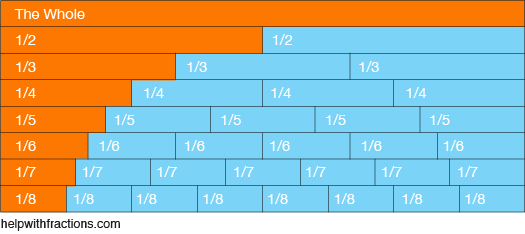
check mark The Part-Whole - The part-whole explanation of a fraction is where a number like 1/5 indicates that a whole has been separated into five equal parts and one of those parts are being considered.

This table is a great help to get a feel of how a fractional part compares to the whole...

The Whole

1/2

1/2

1/3

1/3

1/3

1/4

1/4

1/4

1/4

1/5

1/5

1/5

1/5

1/5

1/6

1/6

1/6

1/6

1/6

1/6

1/7

1/7

1/7

1/7

1/7

1/7

1/7

1/8

1/8

1/8

1/8

1/8

1/8

1/8

1/8

As a homework helper, this table shows you how the "same" whole can be divided into a different number of equal parts.

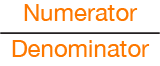
The Division Symbol ("/" or "__") used in a fraction tells you that everything above the division symbol is the numerator and must be treated as if it were one number, and everything below the division symbol is the denominator and also must be treated as if it were one number.
a fraction

Basically, the numerator tells you how many part we are talking about, and the denominator tells you how many parts the whole is divided into. So a fraction like 6/7 tells you that we are looking at six (6) parts of a whole that is divided into seven (7) equal parts.

Although we do not cover fractions as a quotient or as a ratio, here is a brief explanation of them.

check mark A Quotient - The fraction 2/3 may be considered as a quotient, 2 ÷ 3. This explanation also arises from a dividing up situation. For example...

Suppose you want to give some cookies to three people. Well, you could give each person one cookie, then another, and so on until you had given the same amount to each. So,...

If you have six cookies, then you could represent this process with simple math by dividing 6 by 3, and each person would get two cookies.

But what if you only have two cookies? One way to solve the problem is to break-up each cookie into three equal parts and give each person 1/3 of each cookie so that in the end, each person gets 1/3 + 1/3 or 2/3 cookies. So 2 divided by 3 = 2/3.

Here's a brief explanation of...

check mark A Ratio - The fraction 2/3 can also represent a ratio situation, which might be for example, where there are two boys for every three girls in a group. So in this case, two-thirds of the entire group are boys.

Now let's look at some...

left pencil More Help Right pencil
math help

Keep these helpful tips in mind when you work through our homework lessons.

uniqueness of number oneUniqueness of the Number 1

Multiplying any number by 1 does not change the value of the number.

Dividing any number by 1 does not change the value of the number.

Keep in mind...

The number 1 can take on many forms. 3 - 2 = 1 and 20 - 19 = 1 can be used as a substitute for the number 1 because they both have a value of 1. Also... When the numerator of a fraction is equivalent (equal) to the denominator of a fraction, the overall value of the fraction is 1. This only works when you have a legal fraction; that is to say, the denominator does not equal zero. You can substitute any of these fractions for the number 1.

For example... 2/2, 5/5, 31/31, etc., are all the equivalent to the number 1.

interger as a fraction Any Integer Can Be Written as a Fraction

You can express any integer as a fraction by simply dividing by 1, or you can express any integer as a fraction by simply choosing a numerator and denominator so that the overall value is equal to the integer.

Example: The integer "8" can be expressed as the fraction "8/1"  or "16/2" or "32/4" because they all have an overall value equal to "8".

Division by Zero Division by Zero

The denominator of a fraction cannot have the value zero. If the denominator of a fraction is zero, this is not a legal fraction because it's overall value is undefined.

zero in the numeratorZero in the Numerator

The numerator of a fraction can have a value of zero. Any legal fraction (denominator not equal to zero) with a numerator equal to zero has an overall value of "zero."

working with negative numbers One Minus Sign in a Fraction

If there is one minus sign in a simple fraction, the value of the fraction will be negative.

more negative fractions More Than One Minus Sign in Fractions

If there is an even number of minus signs in a fraction, the value of the fraction is positive.

If there is an odd number of minus signs in a fraction, the value of the fraction is negative

factoring integers Factoring Integers

To factor an integer, simply break the integer down into a group of numbers whose product equals the original number. Don't forget that the number 1 is the factor of every number (normally the number 1 is omitted). Any factor of a number can be divided evenly into that number.

Examples:

The factors of the number 12 are 1, 2, 3, 4, 6, 12

The factors of the number 35 are 1, 5, 7, 35

The factors of the number 53 are 1, 53, because 53 is a Prime Number.

Here is an easy short-cut method for finding the prime factors of a number. Simply divide the number by the lowest possible Prime Number until the final resulting answer is a Prime Number.

Example:

factoring  

As you can see in the example, the prime factors of 56 are 2 x 2 x 2 x 7

Keep dividing the resulting number by the smallest prime number that will go into the number evenly. Start with "2" if the number is even. Otherwise start with the lowest prime number possible (3, 5, 7, etc.), until you are left with only a Prime Number.

Click here for a more complete explanation and list of Prime Numbers.

This is a great place to talk about...

reducing a fraction Reducing Fractions

To reduce a fraction, follow the following three steps: 

  1. Factor the numerator.
  2. Factor the denominator. 
  3. Cancel-out fraction mixes that have a value of 1.
  4. Re-write your answer as the reduced fraction.

Example: 

To reduce 24/56 we factor the Numerator (24 = 2 x 2 x 2 x 3) and then factor the Denominator (56 = 2 x 2 x 2 x 7).

factoring

In this example all of the "2s" are eliminated because there are an equal number of 2s in both the numerator and denominator. That's what we mean by a fraction mix that has the value of "1".

The correct answer for the example above is a reduced fraction that's equal to 3/7.

Here's another way to look at this same example. 

You already know that 2/2 = 1, so... 


factoring is the same as factor to three sevenths which is equal to 1 x 1 x 1 x 3/7

Therefore, you would re-write your answer as 3/7.


equivalent fractions Equivalent Fractions

Finding an equivalent fraction (also called building fractions) is the reverse of reducing the fraction. Instead of searching for the 1 in a fraction mix so that you can reduce, you insert a 1 and build. The resulting fraction is called an equivalent fraction.

Try to remember this one, because you will use it a lot in other homework assignments.

Here's how you do it...

Multiplying the numerator and the denominator by the same number, such as 7, is the same as multiplying the original fraction by 1 (since 7/7 = 1). It does not change the value.

Example: 

Find an equivalent fraction for 1/2.

Step 1: Choose any number you wish. Suppose you chose 6.

Step 2: Multiply the numerator and denominator by 6.

six twelfths

Step 3: Write the equivalent fraction. 1/2 = 6/12

1/2 is equivalent to 6/12. An equal sign (=) is used to represent equivalent fractions.


simplifying fractions Simplifying Improper Fractions

You may remember from other homework assignments that an improper fractions is where the numerator has a greater value than that of the denominator. So each time you do a math operation on fractions and your answer ends up as an improper fraction, you must simplify your answer.  Because, the simplified results will be in the form of a mixed number.

So, to convert an improper fraction into a mixed number, just divide the numerator by the denominator. The results will be a whole number part and a fractional part.

Here is an example...

Simplifying Fractions

As you can see, this is a pretty straightforward operation. But keep in mind that if there is no remainder, the answer is the WHOLE NUMBER only.


greatest common factor Greatest Common Factor (GCF)

The greatest common factor of two or more whole numbers is the largest whole number that divides evenly into each of the numbers. There are two ways to find the greatest common factor. Remember to follow your homework instructions, if your teacher asks for a particular method.

The first method is to list all of the factors of each number, then list the common factors and choose the largest one.

Example: Find the GCF of 36 and 54.

The factors of 36 are 1, 2, 3, 4, 6, 9, 12, 18, and 36.

The factors of 54 are 1, 2, 3, 6, 9, 18, 27, and 54.

The common factors of 36 and 54 are 1, 2, 3, 6, 9, 18

Although the numbers in bold are all common factors of both 36 and 54, 18 is the greatest common factor.

The second method is to list the prime factors, then multiply the common prime factors.

Example: Let's use the same numbers, 36 and 54.

The prime factorization of 36 is 2 x 2 x 3 x 3

The prime factorization of 54 is 2 x 3 x 3 x 3

Notice that the prime factorizations of 36 and 54 both have one 2 and two 3s in common. So, we simply multiply these common prime factors to find the greatest common factor. Like this...

2 x 3 x 3 = 18

Both methods work!


least common multiple Least Common Multiple (LCM)

The least common multiple of two or more non-zero whole numbers is actually the smallest whole number that is divisible by each of the numbers. When doing your homework, keep in mind that there are two widely used methods for finding the least common multiple of a group of numbers.

Method 1 - Simply list the multiples of each number (multiply by 2, 3, 4, etc.) then look for the smallest number that appears in each list.

Example: Find the least common multiple for 5, 6, and 15.

  • First we list the multiples of each number.

Multiples of 5 are 10, 15, 20, 25, 30, 35, 40,...

Multiples of 6 are 12, 18, 24, 30, 36, 42, 48,...

Multiples of 15 are 30, 45, 60, 75, 90,....

  • Now, when you look at the list of multiples, you can see that 30 is the smallest number that appears in each list.

  •  Therefore, the least common multiple of 5, 6 and 15 is 30.

Method 2 - Factor each of the numbers into primes. Then for each different prime number in all of the factorizations, do the following...

  1. Count the number of times each prime number appears in each of the factorizations.

  2. For each prime number, take the largest of these counts.

  3. Write down that prime number as many times as you counted for it in step 2.

  4. The least common multiple is the product of all the prime numbers written down.

Example: Find the least common multiple of 5, 6 and 15.

  • Factor into primes

    Prime factorization of 5 is 5

    Prime factorization of 6 is 2 x 3

    Prime factorization of 15 is 3 x 5

  • Notice that the different primes are 2, 3 and 5.

  • Now, we do Step #1 - Count the number of times each prime number appears in each of the factorizations...

    The count of primes in 5 is one 5

    The count of primes in 6 is one 2 and one 3

    The count of primes in 15 is one 3 and one 5

  • Step #2 - For each prime number, take the largest of these counts. So we have...

    The largest count of 2s is one

    The largest count of 3s is one

    The largest count of 5s is one

  • Step #3 - Since we now know the count of each prime number, you simply  - write down that prime number as many times as you counted for it in step 2. 

    Here they are...

    2, 3, 5

  • Step #4 - The least common multiple is the product of all the prime numbers written down.

    2 x 3 x 5 = 30

  • Therefore, the least common multiple of 5, 6 and 15 is 30.


LCDLeast Common Denominator (LCD)

The least common denominator of a fraction is another way of stating the least common multiple of two or more different denominators. They mean the same. So, if you can find the least common multiple of two or more numbers, you can find the least common denominator.

Once you know the least common multiple, you would simply re-express each fraction by building an equivalent fraction using the newly named denominator.

Don't freak out!

We will go over all of this stuff in detail during the math operations that use them.

homework help

That was a lot of homework help and you haven't worked a problem yet. So let's put some this stuff to WORK! But remember this is NOT the actual lesson, just a quick overview of some to the RULES and PRINCIPLES we'll need to use when working with fractions. Don't worry about memorizing everything, you'll see all of this "stuff" again as they apply to a particular operation during the homework lessons. So...

We'll start with the rules for fraction operations...

left pencil  Adding Fractions  Right pencil
help with adding fractions

To add fractions, the denominators must be equal. Complete the following steps to add two fractions. 

  1. Build each fraction (if needed) so that both denominators are equal. 

  2. Add the numerators of the fractions. 

  3. The new denominator will be the denominator of the built-up fractions. 

  4. Reduce or simplify your answer, if needed. 

    1. Factor the numerator. 

    2. Factor the denominator. 

    3. Cancel-out  fraction mixes that have a value of 1.

    4. Re-write your answer as a simplified or reduced fraction.

left pencil Subtracting Fractions Right pencil
subtracting fractions rule

To subtract fractions, the denominators must be equal. You basically following the same steps as in addition. 

  1. Build each fraction (if required) so that both denominators are equal.

  2. Combine the numerators according to the operation of subtraction.

  3. The new denominator will be the denominator of the built-up fractions. 

  4. Reduce or simplify your answer, if needed. 

    1. Factor the numerator. 

    2. Factor the denominator. 

    3. Cancel-out  fraction mixes that have a value of 1.

    4. Re-write your answer as a simplified or reduced fraction.


left pencil Multiplying Fractions Right pencil
multilying fractions rule

To multiply two simple fractions, complete the following steps.

  1. Multiply the numerators. 

  2. Multiply the denominators. 

  3. Reduce or simplify your answer, if needed. 

    1. Factor the numerator. 

    2. Factor the denominator. 

    3. Cancel-out  fraction mixes that have a value of 1.

    4. Re-write your answer as a simplified or reduced fraction.

To multiply a whole number and a fraction, complete the following steps.

  1. Convert the whole number to a fraction.

  2. Multiply the numerators.

  3. Multiply the denominators.

  4. Reduce or simplify your answer, if needed. 

    1. Factor the numerator. 

    2. Factor the denominator. 

    3. Cancel-out  fraction mixes that have a value of 1.

    4. Re-write your answer as a simplified or reduced fraction.


left pencil Dividing Fractions Right pencil
homework dividing fractions

To divide one fraction by a second fraction, convert the problem to multiplication and multiply the two fractions.

  1. Change the "÷" sign to "x" and invert the fraction to the right of the sign. 

  2. Multiply the numerators.

  3. Multiply the denominators. 

  4. Reduce or simplify your answer, if needed. 

    1. Factor the numerator. 

    2. Factor the denominator. 

    3. Cancel-out  fraction mixes that have a value of 1.

    4. Re-write your answer as a simplified or reduced fraction.

To divide a fraction by a whole number, convert the division process to a multiplication process, by using the following steps.

  1. Convert the whole number to a fraction.

  2. Change the  "÷" sign to " x" and invert the fraction to the right of the sign.

  3. Multiply the numerators.

  4. Multiply the denominators.

  5. Reduce or simplify your answer, if needed. 

    1. Factor the numerator. 

    2. Factor the denominator. 

    3. Cancel-out  fraction mixes that have a value of 1.

    4. Re-write your answer as a simplified or reduced fraction.

Best regards,


Skip

homework help

[Math Homework Help]  [Adding Fractions]  [Subtracting Fractions]

[Multiplying Fractions]  [Dividing Fractions]  [Least Common Multiple]

 [Least Common Denominator]  [Greatest Common Factor]

[Equivalent Fractions]  [Simplifying Fractions]  [Reducing Fractions]

[Understanding Fractions]  [Prime Numbers]  [Fraction Calculator]

  homework helper

Webmaster: Skip Akers
Contact:
Mustang, OK  73064
Copyright © Help With Fractions 2003