Home
Rules and Definitions
Adding Fractions
Subtracting Fractions
Multiplying Fractions
Dividing Fractions
Prime Numbers
Fractions Calculator


Subtracting Fractions Is Just Like Adding Them

Subtracting fractions with the same denominator is just as easy as adding them. But we will take nothing for granted. So you can expect the same detailed explanation as always. So let's start our discussion as if this were the first page you saw upon arrival to our site. So,...

The Rules for subtracting fractions state that denominators must be the same. Period.  And since our denominator are already the same...

Let let's begin with the Rule....

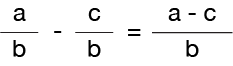
The equation above shows the Rule for subtracting fractions with like denominators. So, if you are subtracting fractions with the same (common) denominator (b), the answer is the difference between the numerators (a - c) over their common denominator.

Remember that a fraction refers to the number of parts in a "whole", and the WHOLE that we are talking about is always the number in the denominator (on the bottom). So, when subtracting  fractions that refer to the "same" whole, all we have to do is subtract the parts and keep our same point of reference.

Yep!

That's all there is to it!

Since you may not have seen the lesson on adding fractions, we'll give you the "rest of the story" so you won't miss out on any of the detail you'll need for subtracting fractions.

As you probably already know, there is a lot more to subtracting fractions than just the difference of the numerators. So, we'll go over some of that extra stuff now.

If you already know who to simplify fractions, which includes reducing fractions, simplifying improper factions, and how to deal with mixed number, you can bypass the rest of this page.

But if not, please read on...

How to Simplify
Your Answers 


Sometimes when you subtract  fractions of any type, you will need to simplify your answer. What that really means is that you must show your results in the "best" form possible. As a result, here are a few more things to think about...

  1. First, your answer may be a higher equivalent fraction, which is better represented in its lowest form. Many teachers will insist that you reduce your answer, whenever possible. 

  2. Also, subtracting two fractions could result in what's called an improper fraction. This is where the numerator is larger than the denominator. To write these answer in their simplest form you will have to convert them to a mixed number. This will show a representation of the Whole Parts and the Fractional Parts.

  3. And finally, you may also be subtracting mixed numbers where the fractional parts have the same denominator. Even with these types of problems, you may need to simplify your answers.

So let's continue with some detailed information about these special cases.

 Reducing Fractions 

Here's the situation. You have subtracted the fractions, but your answer still may not be showing the lowest equivalent fraction. So how do you make sure your answer is shown in its lowest equivalent?

Let's use an easy example so you will get the idea...

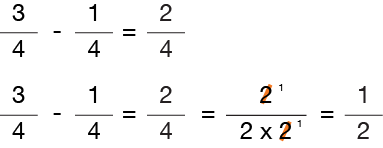
Notice that the original answer to our sample problem is "2/4." To determine if our answer is in its simplest form, we must  factor the numerator and the denominator into its prime numbers. Click here for a review of prime numbers.

What we are looking for are the prime numbers that are common to both the numerator and the denominator. If we find these common numbers, we can then cancel them out. The results will be the lowest equivalent fraction.

Since "2" is a common factor in both the numerator and denominator of our example, it indicates that our answer is not in its simplest form.  Therefore, we will cancel out (/) one of the 2's in both the numerator and denominator by dividing by "2". The results is a reduced fraction in its simplest form.

Here's the Rule...

Always keep in mind...

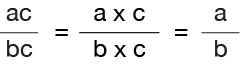
Whatever you do to the numerator of a fraction you must also do to the denominator. So if you have to divide the numerator by a number, you must also divide the denominator by the same number. That way you will not change the overall value of the fraction.

Let's do a little tougher problem to be sure you've got it...

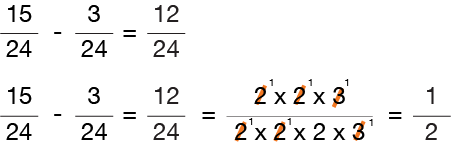
In this problem, a "2" and a "3" can be found in both the numerator and the denominator. Notice how we only cancel-out one-for-one! First we divide the numerator and denominator by "2", then divide both the numerator and denominator by "3."  So what is left in the numerator is 1 x 1 x 1 = 1 and the denominator is 1 x 1 x 2 x 1 = 2. That leaves use with a reduced fraction equal to 1/2.

See what we just did?

GREAT!

Now let's look at how to...

Simplify Improper Fractions

You may remember that an improper fractions is where the numerator has a greater value than that of the denominator. So each time you add two fractions and your answer ends up as an improper fraction, you must simplify your answer.  The results will be in the form of a mixed number.

To convert an improper fraction into a mixed number, just divide the numerator by the denominator. The results will be a whole number part and a fractional part.

Here is an example...

As you can see, this is a pretty straightforward operation. But keep in mind that if there is no remainder, the answer is the WHOLE NUMBER only.

Now that you are the master of subtracting fractions with the same denominator, it is time to tackle a tougher problem...

Subtracting
Mixed Numbers
 

The easiest way to work with mixed numbers is to convert them to improper fractions first, do the math operation, then convert your answer back to a mixed number (if needed).

But first...

Here's the Rule for converting mixed numbers into improper fractions...

To actually do a conversion, it would look like this...

Putting this problem into words...

... to convert 2 1/8 to an improper fraction, we just multiply the Whole Number (2) times the denominator (8), add that answer to the Numerator (1), and keep the denominator of the fractional part. The result is the improper fraction 17/8.

Now let's put this new found knowledge to work and subtract a couple of mixed numbers.

Now all we have to do is subtract our new improper fractions, and simplify. So...

Now there you have it, all you need to be a "master" at subtracting fractions with the same denominator... and a whole lot more.

Best Regards,

More Help With Math Fractions...

Math Homework Helper - Start Here!

Help With Fractions - Home

Adding Fractions - Same Denominator

Adding Fractions - Different Denominators

Subtracting Fractions - Same Denominator

Subtracting Fractions - Different Denominators

Multiplying Fractions

Dividing Fractions

Equivalent Fractions

Reducing Fractions

Simplifying Fractions

Least Common Denominator (LCD)

Least Common Multiple (LCM)

Greatest Common Factor (GCF)

Prime Numbers Chart - A Helpful Tool


Webmaster: Skip Akers
Contact: skip@helpwithfractions.com 
Mustang, Oklahoma 73064
Copyright © Help With Fractions 2003